Magnet and Ph in the Body Peer Review
Full general
General
Application | Full general Questions | General EO Questions | Nursing Satisfaction, Nursing Sensitive Indicators and Patient Satisfaction (Big 5) Full general Questions | Download PDF
Application
Q - Is it acceptable for the organizational and/or nursing organizational charts to exist updated to reflect organizational changes from time of awarding to certificate submission? (updated Feb 2020)
- Yes, you should submit the about current Organizational and Nursing Organizational charts at the fourth dimension of awarding, document submission and once again prior to site visit (SV).
General Questions
Q - Are observational units, labor and delivery, and the OR considered to exist inpatient or ambulatory units? (updated February 2020)
- This is an organizational determination and information technology tin depend heavily on how the externally managed database categorizes these units/convalescent care settings. After the classification is determined, the areas must exist consistently reported as inpatient or outpatient throughout the document.
Q - For examples that are specific to ambulatory areas, can the story have place in both inpatient and ambulatory areas? (Updated February 2021)
- Convalescent examples must be specific to the ambulatory setting; all data must exist from the convalescent setting likewise.
Q - Why are Analysts unable to confirm if an outcome measure is acceptable? (June 2020)
- The Senior Magnet Program Analyst (SMPA) role is that of a subject area matter expert, clarifying program requirements, definitions, terms, and content in the 2019 Magnet Application manual. This function is distinctly unlike from the Magnet Appraisers that assess your examples or consultants that help you to develop your examples. It is an organizational decision to seek guidance from a consulting firm.
- The SMPA asks questions to help bulldoze an appropriate result measure out. For example, what is the impact of the initiative on the patient(due south), nursing workforce, or organization? Why did you implement the process/intervention? What information-driven problem in your organisation/unit prompted this initiative?
General EO Questions
Q - If an intervention is implemented on the showtime mean solar day of the month/quarter, tin information from the month/quarter be considered post-intervention data? (FAQ December 2016. Updated February 2020)
- Yes, however, just if the intervention is instituted and completed on the first 24-hour interval of the calendar month/quarter (east.one thousand., July 1st).
Q - What format should exist used to nowadays participant information for an EO SOE case? (updated February 2020)
- Refer to folio 17 in 2019 Magnet Awarding Transmission. It is an organizational decision if you lot refer to these individuals by name or initials in the SOE example. However, the information provided in the example, must marshal with the information provided on the participant table. A meeting sign-in sheet is non required in addition to the participant table as a part of an EO instance. A specific participant tabular array format is non required merely the name, bailiwick, championship, and department must exist included.
Q - What if my mail service-intervention data do not testify three consecutive improvement points—the trend line is improved, just there is variability in the postal service-intervention information points? (FAQ Dec 2016, updated February 2020)
- If the empirical bear witness SOE requests that comeback exist demonstrated, the post-intervention data may show variability; however, it must evidence a trend of improvement when compared to the pre-intervention data.
- Trendlines are acceptable, but not a required chemical element of an EO graph as outlined on page 17-18 in the 2019 Magnet Application Manual.
- Notation: Data provided during the intervention period are non included in the appraiser's evaluation of improvement or modify.
Q - What timeframe should be used to nowadays quarters on an EO graph? (updated February 2020)
- The Magnet Program Office is non prescriptive equally to the units of time used. However, the timeframe must be the aforementioned for pre-intervention and post-intervention data. The timeframe must too exist consecutive and should not overlap. Delight run into page 18 in the 2019 Magnet Application Manual.
Q - Is information technology acceptable to use raw numbers in an EO information presentation? (June 2020)
- Outcome information must be presented as a ratio (e.m., rate, percentage, boilerplate, mean, median) consistently throughout the data drove catamenia. The merely exception is with a sentinel or never issue.
Nursing Satisfaction, Nursing Sensitive Indicators and Patient Satisfaction (Big Five) General Questions
Q - During site visit will the appraisers expect to run across updated data or will they only be validating the information provided during document submission? (updated February 2020)
- The expectation is for the appraisers to validate the data presented in the certificate against source data provided by the vendor during site visit.
- If there are deficiencies found within your Big 5 data going into site visit, the appraisers will await only to see data that validates those particular deficiencies
Q - Can you selection different comparison groups or cohorts for each category? i.east. Autonomy academic centers, professional development national (updated Feb 2020)
- Yes, you may present different comparison cohorts for each unit or clinic.
- The comparison accomplice must exist aforementioned for the units or clinics presented on the aforementioned graph
- The comparison accomplice must be an appropriate comparison.
- Delight see page 55-56 in the 2019 Magnet Awarding Manual.
Q - Is the expectation to collect data Patient Satisfaction data in all ambulatory areas where nurses provide care? (updated Feb 2020)
- Yes. Information must exist collected for the following convalescent care settings: Emergency Department, Ambulatory Surgery Center and all other ambulatory areas where clinical nurses provide care. Piece of work with an externally managed database to establish appropriate ambulatory information drove.
- Delight see page 57 in the 2019 Magnet Application Manual.
Q - My organization has no ambulatory care settings, do I demand to consummate EP19EO or EP21EO? (updated February 2020)
- For organizations where there are no ambulatory care settings nothing needs to be submitted for EP19EO or EP21EO.
- For Magnet purposes, convalescent care settings include emergency departments and urgent care.
Organizational Overview
Organizational Overview
OO-i | OO-5 | OO-6 | OO-x | Download PDF
OO-1
Q - What is the definition of demographics? (updated September 2019)
For Magnet purposes, the population and RN statistical characteristics that are pertinent to the system. These may include, only are not limited to, age, gender, and education of the population served and nursing (RN) staff.
Q - If the clarification of the history of the organization is greater than 300 words, what happens? (updated September 2019)
The appraisers evaluate the first 300 words to determine if the Organizational Overview particular has been met. If it is not met in the first 300 words, a request for Boosted Information will be generated.
OO-5
Q - Does the continuing education cess provided need to be completed? (Updated September 2019)
Yeah, the assessment must be the summary (completed, with results) of the information gathered in the most recent needs cess.
Q - What is meant by "all RNs" and "all settings"? (updated September 2019)
A continuing educational cess must be offered to all registered nurses, in all areas (settings) where registered nurses work in the organization. This should include the CNO, Nurse AVP/Directors, Nurse Managers, Clinical Nurses, APRNs, and whatever other registered nurse position.
The continuing needs assessment must demonstrate that the needs of nurses in the various settings are being addressed (i.east. inpatient, ambulatory, administration, etc.). For instance, the clinical nurses in the ICU volition accept very different needs assessment than ambulatory nurses in a primary care clinic
Q - What is the pregnant of the word "assessment"? (updated September 2019)
An cess is the procedure the organisation does to identify whatever potential gaps in knowledge, skills, and abilities of the registered nurses in areas where they practise. The cess tin be accomplished in numerous ways, including a cocky-assessment of nurses in the grade of a survey or other reporting. An assessment can also exist accomplished with input from committees and other formal structures such equally the pedagogy department, hazard management, infection control and nursing leadership to identify the continuing teaching needs for all registered nurses. The assessment must be inclusive of all levels of nursing, including the CNO, AVP/Directors and Managers, clinical nurses, and APRNs.
Q - What levels of nursing need to be included in the instruction assessment? (FAQ April 2019, updated February 2020)
- All registered nurses who influence or provide care in all settings of your organization must be represented in the educational activity cess. Apply the post-obit table as a tool to guide inclusion of all nurses.
This sample table is provided to demonstrate how an applicant may choose to organize their documentation for OO5 to ensure that an assessment of continuing educational activity is existence completed for "all RNs" in "all settings"
| "All RNs who influence or provide care" (Note: It must exist clear that the organization completes a standing education cess at all levels of nursing) | "All Settings where RNs practice" (Annotation: It must exist clear that the organization completes a continuing instruction assessment for RNs in all settings, such as Inpatient, Ambulatory, and medical practice settings.) |
| CNO | Executive setting |
| AVP/Directors/Nurse Managers | Leadership, Management setting |
| Clinical Nurses | ICU, Medical, Surgical, Ortho, Neuro, Ambulatory Medical Clinics, Interventional Radiology, setting etc. |
| APRNs | Inpatient and Ambulatory Intendance setting |
| Others, e.k., Centralized Function | Case Managers, Infection Control, and other setting that may have unique educational needs, etc. |
| Each organisation will identify the level of nurse and the settings according to their ain organizational processes and provide the most recent continuing educational assessment completed with the results. Evidence must back up that the organization has completed a continuing didactics assessment on all RNs in all settings. | |
Q - Must the continuing teaching cess include a survey? Our organization uses other tools to build the cess such equally performance appraisals and quality and adventure data. (June 2020)
The methods used for the continuing educational needs assessment is an organizational conclusion. The bodily continuing educational needs assessment may include a survey or other modalities (i.e., RN self-identified needs, hazard assessments, etc.).
OO-6
Q - Are there eligibility criteria for the private that the CNO chooses to designate to participate in the credentialing, privileging and evaluating of APRNs? (updated September 2019)
The CNO is ultimately responsible for sustaining the standards of nursing practice throughout the organization, including APRN practise, regardless of reporting relationships. The designee must be an RN and must communicate with the CNO.
Q - What is the expectation of the CNO's (or RN designee's) "participation" in the credentialing, privileging, and evaluating process of all advanced practiced registered nurses (APRNs)? Practise we need to describe the CNO (or designee) in every phase of credentialing? (updated September 2019)
A clarification of the CNO's (or RN designee'southward) participation in the credentialing and evaluation of all APRNs should be a broad description of the process. It should include the CNO's (or designee's) roles in credentialing, privileging, and evaluating and how the CNO (or designee) are involved/participate in the process.
OO-10
Q - Can we include evidence-based practice (EBP) and "exempt" nursing research on our research table? (FAQ Dec 2016, updated February 2020)
- Provide the institutional review board (IRB) approval engagement and type of review (i.e. total board, expedited, and exempt) of the nursing research study, that is ongoing and/or completed within the applicant arrangement(due south).
- Only nursing research studies are to be listed on the tabular array. Evidence-based projects, procedure improvement, and quality improvement projects should not be included on the nursing research table.
- This table includes nursing inquiry studies that are completed or ongoing inside the twoscore-eight months before documentation submission. Information technology is acceptable for the written report to begin outside the twoscore-8 timeframe.
Q - Can we include nursing research on our enquiry table that is conducted at our organization by nonemployees (Ph.D./DNP students, university faculty)? (FAQ December 2016, updated February 2020)
- No, the nursing inquiry listed on the research table must be conducted by employees of the organization (i.e., PI, co-PI, and/or site PI).
- Every bit long equally an employee of the organization serves in at to the lowest degree i of these roles, the PI, co-PI, or site PI function, a nonemployee may be involved in the nursing research.
Q - What is meant past a completed nursing enquiry study? (updated Feb 2020)
For Magnet purposes, a "completed study" refers to a study that has concluded to the point of analysis and from which initial implications of the findings accept been determined and broadcasting has occurred or will occur. The study must be completed inside the 48-month timeline. The study may starting time prior to the 48-month timeline.
Transformational Leadership
Transformational Leadership
TL3 | TL5EO | TL6 | TL7 | TL9EO | Download PDF
TL3
Q - Does the advancement for resources hateful the resources must exist acquired? Does the resources accept to be a man resources? (updated February 2020)
- The advocacy does not need to result in the acquisition of the resources.
- The resources does not demand to be a person, it could be such things as the acquisition of time, money, equipment, technology.
Q - My organization does not accept all the levels that are requested in the source of evidence for TL3. How do I respond to the required source of evidence request argument? (updated September 2019)
Two examples must be provided for TL3. In the case of a flat organizational nursing leadership structure (i.due east. either only Nurse Managers or merely AVP/Nurse Directors) ii examples are required using the nurse levels that be in the organisation. For instance, if there are no Nurse Managers then the organization will need to supply two AVP/manager examples.
TL5EO
Q - Does the arrangement-level, decision-making grouping also need to be interprofessional? (updated February 2020)
- This source does not require the organization-level, controlling group to too be interprofessional.
Q - Does the improved patient consequence need to be captured at the system level? (updated February 2020)
- The improved patient outcome can occur at any level within the organization (organization level, division, or unit/clinic). The narrative needs to explain how the membership in the system-level, decision-making group led to the interventions and effect.
TL6
Q-What is the definition of mentoring? (updated September 2019)
Mentoring is providing information, communication, back up and ideas to a person in their current role. Annotation: The term mentor and preceptor are not used interchangeably. See glossary definition of mentor pg. 152.
Q: Does the mentor associated with a mentoring plan or program demand to be a nurse? (updated September 2019)
- TL6a-d: For the clinical nurse, APRN, nurse manager, and nurse AVP/Managing director examples, the mentor must be a registered nurse. Please refer to the definition for mentor (2019 Magnet Awarding Manual, pg. 152)
- TL6e: For the CNO example, the mentor may exist a registered nurse or a not-nurse.
Q-Does the mentor have to be from inside the organization? (updated Feb 2020)
- It is acceptable to use system-level system mentor programs or plans, equally long as the mentoring is occurring inside and supported by the organization. The mentorship can be formal or informal.
- The organisation must employ the mentee. The organization or arrangement must employ the mentor.
- All registered nurses must be mentored by registered nurses or APRNs, except for the CNO.
- TL6e (CNO): The CNO may exist mentored by nurses or non-nurses, inside or outside the organisation; however, the narrative must reverberate organizational support for this mentoring.
TL7
Q-What is the definition of succession planning? (updated September 2019)
Succession planning is preparing a nurse to move into a new role. For Magnet purposes, the succession planning activities of the private does non have to consequence in entrance into the new role. However, the activities that move(d) them into the new part must have occurred. See glossary definition on pg. 161
The intent is that nurses are being prepared through succession-planning activities to move into 1 of the four options listed. For case, succession-planning activities for the CNO role might include activities for the Associate CNO or another nurse executive preparing to assume (or already assumed) the CNO'south responsibilities.
Q-My organization does not have all the levels that are requested in the source of evidence for TL7. How practice I reply to the required source of evidence request statement? (updated September 2019)
Three examples must be provided for TL7 (one from an ambulatory setting) using the nurse levels that exist in the organization. If the applicant system has a flat construction, the system must provide three examples using the nurse levels that exist in the organization.
Q-Can I use a role not expressly identified in the four options listed? Nosotros accept nurse educators, infection control, and other professional development specialist roles. (updated September 2019)
Merely if one of these roles meets the definition of the iv options provided. We recognize there are other opportunities for succession-planning merely these four are the but options included in the Sources of Evidence.
TL9EO
Q-For the advice between the clinical nurse and the CNO/AVP/nurse director/nurse managing director, does information technology demand to be direct or indirect communication? (updated February 2020)
- Either direct or indirect communication is acceptable for TL9EO. In either blazon of advice, it must be clear that the communication is two-way.
- When communication is indirect, it must be clear that letters are received and returned from/to the clinical nurse and the nurse leader in the example.
Structural Empowerment
Structural Empowerment
SE2EOa | SE2EOb | SE3/SE5 | SE4EO | SE4EOa | SE4EOb | SE4EO/SE6EO | SE6EO | SE8EO | SE9 | SE10 | SE10a | SE11 | SE12 | Download PDF
SE2EOa
Q - Does the professional system need to be a nursing arrangement? (June 2020)
The clinical nurse's or clinical nurses' amalgamation is not limited to nursing professional organizations simply must be with a professional organization.
Collaboratives, consortiums, think-tanks, and conferences are examples that practice not run into the definition of professional organization in the 2019 Magnet manual because they practise not offering individual membership or set standards of practice for the profession.
Q - What is the definition of affiliation? (June 2020)
For Magnet purposes, affiliation does non require membership of a professional arrangement. Affiliation activities may involve a clinical nurse(southward) reading an article or attending a conference of a professional person arrangement that may stimulate your system to rethink an testify-based alter in nursing practise, resulting in an improved patient upshot.
SE2EOb
Q - What is the definition of participation? (June 2020)
Participation in a nursing professional organization may include membership, conference attendance, meeting attendance, etc. The clinical nurse(s) in the example must have participated in a nursing professional arrangement and learned of the application of nursing standards of exercise resulting in an improved patient consequence.
SE3/SE5
Q - Is it is okay for the target to be established outside the 48-calendar month window? (updated September 2019)
If an organisation has established a target outside of the 48-months, there must exist narrative and supporting testify that shows how this goal was re-established during the 48-month timeframe.
SE4EO
Q - Is the list of National Certifications currently Included in the DDCT irresolute to include only lath certifications? (October 2021)
Yes, the listing of National Certifications currently Included in the DDCT is changing to include only board certifications. The current list will be in effect until December 31, 2023. Please refer to data on the Magnet Website related to Accepted Certifications in the DDCT (https://world wide web.nursingworld.org/organizational-programs/magnet/program-tools/accepted-certifications/) about implementation of the new process.
Q - What certifications are adequate to use for Magnet designation? (updated February 2020)
Please refer to the listing of accepted National Certifications.
Q - Do we need to provide a certification goal for each year presented, or tin we develop a goal for our organization to run across past the end of year two? (FAQ December 2016, updated February 2020)
- You may provide a yearly goal OR a goal for improvement past the terminate of yr ii. In either case, 3 years' worth of graphed data must be provided.
- If yous cull to develop a goal for comeback by the end of twelvemonth two, you must include progression data for year 1.
- You must demonstrate that nursing has met the targeted goal for improvement (or maintenance as applicable) in professional nursing certification.
Q - If we choose to use a maintenance goal, does it take to exist the same equally the current level (i.e. electric current level is lx%, can maintenance goal be 55%)? (updated February 2020)
Maintenance is based on if the organization is >51%. If the current level is threescore% it is acceptable to take a maintenance goal every bit low every bit 51%
Q - For SE4EO, what can be considered as organization level? For case, can organizational level be all clinical nurses or all nurse managers/directors or all specialty nurses? (June 2020)
An organization-level group includes nurses from all departments or divisions, due east.yard., all nurse managers beyond the applicant organization both inpatient and outpatient, or all specialty nurses.
SE4EOa
Q - Are cohort groups at the organizational level an acceptable presentation for an comeback in organizational level professional person nursing certification? (June 2020)
An organization-level cohort is an acceptable presentation, e.m. all nurse managers across the organization.
SE4EOb
Q - Are cohort groups at the unit or sectionalization level an acceptable presentation for an improvement in unit or partition level professional person nursing certification? (June 2020)
A unit- or division-level cohort is an acceptable presentation, eastward.g. all clinical nurses beyond the partition.
SE4EO/SE6EO
Q - Is narrative required for SE4EOa and b and SE6EO? (updated Feb 2020)
No, narrative is not required.
An explanation is required if an organisation experiences a merger, conquering or expansion occurs within the 3 years altering the ability to meet the established goal, the organization is allowed to reestablish a goal and show progress toward the revised goal.
Q - Practise the three years of graphed information need to be presented equally calendar years? (updated Feb 2020)
No, whatsoever iii completed years of graphed data are acceptable as long equally the timeframes are complete.
SE6EO
Q - If we choose to use a maintenance goal, does it have to be the same as the current level (e.g., current level is 85%, can maintenance goal be 82%)? (updated February 2020)
- Maintenance is based on if the organisation is >80%. If the current level is 85% it is acceptable to have a maintenance goal as low as 80%
- You must demonstrate that nursing has met the stated goal for comeback (or maintenance if applicative) in baccalaureate or higher caste in nursing.
SE8EO
Q - Can the nursing continuing education assessment include multiple professions? (updated September 2019)
An interprofessional needs cess is acceptable, yet, the supporting evidence must demonstrate the registered nurses are a part of the needs assessment and implementation program. The example provided, should be specific to nursing.
SE9
Q - What New Graduate transition programs are on the list of recognized programs in the 2019 manual? (updated September 2019)
"Iii national accreditation programs that meet Magnet criteria are ANCC Practice Transition Accreditation Programme (PTAP), Commission of Collegiate Nursing Education (CCNE), and Accreditation Commission for Pedagogy in Nursing (ACEN)." The ANCC PTAP program accredits RN Residency, RN Fellowship, and APRN Fellowship programs. CCNE accredits entry-to-practise nurse residency programs.
Larn more about ANCC's PTAP at: https://www.nursingworld.org/organizational-programs/accreditation/ptap/
Learn more most CCNE accreditation at www.ccneaccreditation.org
Q - If an organization obtains the RN residency program accreditation at a corporate level, would that run into the SE9 standard at the arrangement level? (updated September 2019)
Since Practise Transition Accreditation Program (PTAP) and Committee on Collegiate Nursing Teaching (CCNE) accreditations are programmatic credentials, the entities in a Organization included in the accreditation are all eligible for meeting SE nine in the 2019 Magnet® Awarding Manual.
The System certificate (or other documentation) needs to identify the entities within the Arrangement associated with the credential. The bidder entity must be named in the certificate to meet the requirement for SE9.
Q - Can we use system transition to practice programs to meet the required elements for SE9b-f? (updated February 2020)
It is adequate to use a organisation-level arrangement transition to practice program, as long every bit the example provided is for an individual employed past the bidder organization, and the required elements prove apply by the applicant organisation.
Q - Are we able to have six pieces of evidence for SE9 since there are six elements of transition to practice? (updated February 2020)
No, only 5 pieces of evidence are permitted per instance. I piece of testify may meet multiple elements.
Q - Does the evidence of participation in i of the two approved transition programs demand to include more than than just the New Graduate transition? (June 2020)
Any nurse residency or transition program tin be evaluated past either ANCC or CCNE and if credentialed by either body, that certification is adequate and fully meets SE9 (2019 Magnet Application manual).
During site visit, the appraisers will validate that principles of the six elements of transition to practice programs are axiomatic in the organization.
SE10
Q - I am a nurse who runs a camp for kids with medical bug, that is a office of my function and I am paid to nourish (including weekends). Does this meet the intent of organizational support? (June 2020)
The intent is the nurse is a volunteer, working for or on an initiative outside of their role expectations. Organizational support is related to how the arrangement supports the RNs who volunteer for these types of initiatives
SE10a
Q - Nurses volunteer for international outreach trips on behalf of our organization. Exercise international trips meet the intent for this Source of Evidence? (updated September 2019)
No. The Source of Show specifically references local or regional customs healthcare initiative(s). Local or regional reflect geographically near the healthcare organization.
SE11
Q - Does the example need to describe both culturally and socially sensitive care? (updated September 2019)
No; it is adequate to submit an instance that describes culturally and/or socially sensitive care.
SE12
Q - I heard that organizations cannot use the DAISY honor for this example. (June 2020)
The DAISY honour may be used for SE12 as long as the contributions of the nurse or grouping of nurses addresses the strategic priorities of the arrangement.
Exemplary Professional Practice
Exemplary Professional person Practice
EP1EOa/b | EP2EO | EP5 | EP6EO | EP8EO | EP9a | EP9b | EP10EOa | EP11 | EP14 | EP15EO | Q1 & Q2 Data Presentation | EP18EO | EP18EO/EP20EO | NHSN SIR | EP18EOc and/or d | EP19EO/EP21EO | EP19EO | EP20EO/EP21EO | EP21EO | Download PDF
EP1EOa/b
Q - Should we submit a schematic of the PPM for both EP1EOa and EP1EOb? (updated September 2019)
Yes, each case should have the schematic of the PPM included. Since the PPM must align with each instance; it would be helpful if the applicative part of the PPM is highlighted for the appraiser's review.
EP2EO
Q - Our nurse satisfaction vendor, does non include "all nurses" (i.east. not only clinical nurses, inclusive of APRNs and nursing leaders) in the survey or in the presentation of data for nurse satisfaction. Since the SOE requires "all nurses", how should nosotros handle this? (updated September 2019)
It is required to "include all nursing levels collected and benchmarked by the vendor". You must also provide an caption in your Unit Level Data Crosswalk (ULDC) when your vendor does non survey a nursing level or area of care.
Q - Exercise organizations accept to outperform on their nursing satisfaction survey to move to Site Visit? (Constructive February 1, 2019)
To progress to Site Visit, bidder organizations must meet the thresholds of nursing excellence including demonstrating outperformance of the national vendor'south criterion for at least three out of iv selected nurse satisfaction categories on the majority of reporting units/settings.
https://www.nursingworld.org/~495227/globalassets/docs/ancc/web-detect-12518.pdf
EP5
Q - What does spectrum of healthcare services mean? (updated February 2020)
Spectrum of healthcare services is inclusive of all services and settings where the organization provides intendance.
The spectrum of healthcare services describes the transition of intendance across an entire organization using an interdisciplinary approach to identify factors that may touch on clinical outcomes.
EP6EO
Q - What is meant by a divers patient population? (June 2020)
A divers patient population is a grouping of healthcare consumers to include only not limited:
- Age (e.thousand., teens, elderly, infants)
- Gender (e.k., males, females, transgender)
- Diagnosis specific (e.grand., diabetes, COPD, CHF)
- Intendance specific (e.g., ventilated patients, disquisitional care)
EP8EO
Q - Is the interprofessional educational activity activity referring to education for patients or staff? (Updated September 2019)
Interprofessional pedagogy is didactics for patients, inter-professionals, or nurses led or co-led by a nurse and inclusive of other professions (e.one thousand., occupational therapy, medicine, surgery, concrete therapy)
EP9a
Q - Is the unit-level staffing need specific to registered nurses? (Updated February 2020)
Addressing an identified unit-level staffing need is non express to registered nurses. However, the instance must demonstrate clinical nurses collaborated with an AVP/nurse managing director to address the unit of measurement-level staffing need related to groups such every bit physician, respiratory, or unlicensed assistive personnel.
EP9a and b
Q - My organization does non have all the levels that are requested in the source of evidence for EP9a and EP9b. How practice I respond to the required source of evidence request argument? (June 2020)
The applicant organization must provide two examples, one for EP9a and one for EP9b. In the example of a flat organizational nursing leadership construction (i.due east. either Nurse Manager or AVP/Nurse Director) two examples are required using the nurse level that exists in the organization.
EP9b
Q - What is considered an operational demand? (June 2020)
An operational need is an identified gap that inhibits the power of nurses to work in an efficient and effective manner (due east.g., equipment, supplies, or time) to perform their jobs.
EP10EOa
Q - Are cohorts accepted for the organization's turnover rate? (updated September 2019)
No. The intention for this source is the organization's nurse turnover rate.
EP11
Q - What are the expectations for peer feedback? (Updated June 2020)
- Please see the definition of peer feedback on page 156 of the 2019 Magnet Transmission.
- Outside of the CNO, a peer should be a registered nurse or an APRN, who possesses a similar role and education, clinical expertise, and level of licensure.
- The CNO may receive peer feedback from other disciplines exterior of nursing as long as the peer can be substantiated.
- The MPO is non prescriptive nigh the formatting or timing of the peer feedback. The organization must follow their established peer feedback process, describe the peer review process and provide evidence to substantiate the process.
- For nurses and APRNs who may be the simply nurse within a setting, consider other resource, including but not express to committee members and shared governance councils to ensure these nurses are receiving and providing peer feedback.
Q - As a role of the periodic formal performance review, are nosotros expected to present the performance review from the current year? (June 2020)
The 2019 Magnet Application Manual does not crave a formal performance review for the current yr; however, the Magnet Program Part (MPO) does expect an organization to follow its own policy related to the frequency of a formal performance review. At a minimum, the instance must fall inside 48-months prior to documentation submission.
EP14
Q - What constitutes an interprofessional group? (Updated February 2020)
- Please refer to the definition of interprofessional collaborative practice on page 151 of the 2019 Magnet Manual
- Within the context of the example, the interprofessional group may include professionals in non-clinical roles (due east.thousand., Security Director), even so the group must encompass nursing.
EP15EO
Q - What is meant by the arrangement'southward safety strategy? (Updated February 2020)
- The organisation'south rubber strategy should be a plan or a framework for achieving the organisation'south safety objectives.
- The system's safety strategy can be overarching with wide categories, (due east.one thousand., patient safety, employee/workplace condom).
Q1 and Q2 2020 Information Presentation
Q1 and Q2 2020 Data Presentation for EP18EO, EP19EO, EP20EO and EP21EO (Updated May 2020)
Organizations without a disruption to Q1 and Q2 2020 in data collection and reporting for EP18EO, EP19EO, EP20EO and EP21EO must submit every bit required in the 2019 Magnet Application Manual®.
Organizations with a disruption in data drove and reporting for Q1 and Q2 2020 data for EP18EO, EP19EO, EP20EO and/or EP21EO due to COVID-19, must submit the most recent available 8 quarters. To practise this, the organisation may demand to present additional quarters (upwardly to a total of 10 quarters) to business relationship for the missing quarters indicated equally unavailable.
- For each missing quarter of data, the organization will tape "COVID-19", on the graph, data tabular array and Unit of measurement Level Data Crosswalk (ULDC).
- If unable to indicate COVID-xix in information table, please indicate caption for missing information under the data table.
As e'er, please reach out to your assigned Senior Magnet Programme Annotator for any questions.
Sample information tabular array:
2Q2018 | 3Q2018 | 4Q2018 | 1Q2019 | 2Q2019 | 3Q2019 | 4Q2019 | 1Q2020 | 2Q2020 | 3Q2020 | |
Unit A | 2.22 | two.47 | 3.77 | iv.01 | ane.98 | 1.43 | 1.55 | COVID-xix | COVID-19 | 1.17 |
Unit B | 1.87 | i.23 | 1.43 | ii.17 | 1.06 | 2.thirteen | 2.76 | COVID-19 | COVID-xix | three.44 |
[Specify: National Database National comparison accomplice; National benchmark statistic] | 1.78 | 1.93 | 2.37 | 3.x | 2.59 | 1.99 | 2.44 | COVID-19 | COVID-19 | three.00 |
Sample of data table with explanation of missing data below:
2Q2018 | 3Q2018 | 4Q2018 | 1Q2019 | 2Q2019 | 3Q2019 | 4Q2019 | 1Q2020 | 2Q2020 | 3Q2020 | |
Unit A | 2.22 | 2.47 | 3.77 | two.47 | iii.77 | 4.01 | 1.98 | * | * | one.17 |
Unit B | 1.87 | 1.23 | ane.43 | 1.23 | i.43 | 2.17 | one.06 | * | * | 3.44 |
[Specify: National database; National comparing accomplice; National benchmark statistic] | 1.78 | 1.93 | 2.37 | one.93 | 2.37 | 3.ten | 2.59 | * | * | 3.00 |
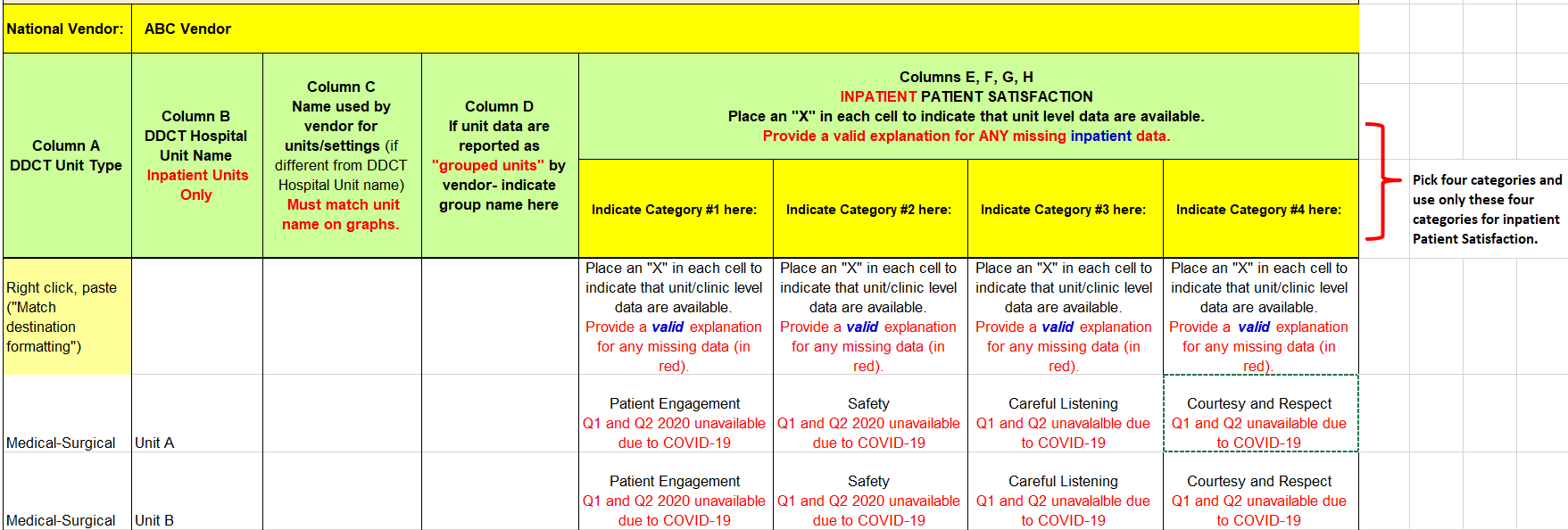
Sample ULDC (click here for pdf version):
EP18EO
Q - What data needs to be submitted for EP18EO for an International Organization?
Please refer to: https://www.nursingworld.org/organizational-programs/magnet/international/
Q - Since nosotros must employ a national benchmark for EP18EO a through d, if the vendor does not provide unit of measurement level data, but rather organisation level data, would this be adequate? (Updated September 2019)
No, you must provide 8 quarters of nationally benchmarked information at the unit level, where the vendor collects the clinical indicator. If unit level data is not bachelor, some other clinical indicator should be selected. Remember, Falls with Injury and HAPI stage 2 and above are required.
EP18EO/EP20EO
Q - I am in an arrangement with no inpatient units, what is my requirement for EP18EO and EP 20EO? (June 2020)
Organizations without inpatient units do not demand to submit substitute information for EP18EO or EP20EO.
NHSN SIR (FAQ May 2017, updated February 2020)
Q - May we use the NHSN Standardized Infection Ratio (SIR) metric when submitting CLABSI and CAUTI (or other nurse-sensitive clinical indicator) information?
Information from the CDC National Healthcare Safety Network (NHSN), A Guide to the SIR (Jan. 2017) indicates that "SIRs are currently not calculated when the number of predicted infections is less than one.0". Consequently, there is a high likelihood that quarterly, nationally benchmarked, unit-level SIR data may not be consistently available to organizations in order to demonstrate outperformance of a national benchmark over the majority of the most recent eight quarters. Since majority outperformance of a national benchmark over the bulk of the well-nigh contempo eight quarters is required to meet Magnet expectations for each EP18EO nurse-sensitive clinical indicator (NSI), the SIR is unacceptable for utilise as a national benchmark for nurse-sensitive clinical indicator data, unless a calculated SIR is available for at least the majority of the 8 quarters of unit of measurement-level data for the majority of applicable units.
EP18EOc and/or d
Q - Can nosotros use the core measure VTE-1 (VTE prophylaxis on admission or by Hospital mean solar day ane)? (updated September 2019)
No, the Core Measure out of VTE describes procedure, not an result measure. For instance, prophylaxis or other methods to preclude VTE correspond procedure. The event of that process is a decrease in the VTE.
EP19EO/EP21EO
Q - My organisation has no ambulatory areas, what is my requirement for EP19EO and EP21EO? (June 2020)
Organizations without ambulatory areas do not need to submit substitute information for EP19EO or EP21EO. Note, the Magnet Recognition Program considers the Emergency Department an convalescent surface area.
EP19EO
Q - Is an explanation about how the selected indicator is nurse sensitive required for each source? (electric current FAQ as of September 2019, updated February 2020)
- Yeah, an explanation must be included for "how the selected indicator is nurse sensitive" in the arrangement.
- If the outcome measure is on the option list on pages 53 and 54 of the 2019 Magnet Awarding Manual, no caption is required for how the selected indicator is nurse sensitive.
- Nurse Sensitive Clinical Indicators for Ambulatory must be provided for each SOE for both clinics (two examples) and/or standalone ambulatory facilities (4 examples).
Q - Should data be presented for just the ambulatory surgical center patient burns or for all convalescent patient burns? (June 2020)
The information presentation is dependent upon where the vendor collects the information. If data is collected at multiple locations, the expectation is to present the data at the clinic level where information technology is collected.
EP20EO/EP21EO
Q - How is patient satisfaction evaluated? (Updated February 2020)
- You must present four patient satisfaction categories for the inpatient setting (EP20EO) and four patient satisfaction categories for the convalescent setting (EP21EO). Therefore, a full of eight SOE examples are required and evaluated individually for patient satisfaction.
- Applicant organizations must see the threshold of nursing excellence including demonstrating outperformance of the national vendor's benchmark for at least five out of eight quarters on the majority of the reporting inpatient units/ambulatory units or clinics.
EP21EO
Q - How should data exist presented if there is a change in vendors during the 8 quarter prior to document submission? (Updated February 2020)
Present carve up graphs for data from the two vendors. For example, 4 quarters from the one-time vendor then a new graph with four quarter from the new vendor. Each graph should exist set up according to the instructions in the 2019 Manual, on page 55-56 or use vendor graphs where applicable.
New Noesis Innovations and Improvements
New Knowledge, Innovations and Improvements
NK1 | NK2 | NK3a/3b | NK6EO | NK7EO | NK7EOb | Download PDF
NK1
Q - What is a "completed" study? (updated September 2019)
For Magnet purposes, a "completed study" refers to a study that has ended to the point of assay and from which initial implications of the findings have been determined and dissemination has occurred or volition occur. The study must be completed within the 48-month timeline. The study may showtime prior to the 48-month timeline.
NK2
Q - For our nursing research can nosotros apply the same written report for NK2 as nosotros utilize for NK1? (updated September 2019)
No. The bidder organization must employ a unlike report for NK2 than is used for NK1. Both studies (NK1 and NK2) must have been completed within the 48-month awarding timeframe.
Q - Must a clinical nurse be listed as an investigator (Principal or sub-investigator) on the nursing enquiry protocol used as the example for NK2? (updated September 2019)
Clinical nurses practice not have to be PI or co-PI for NK2 but they need to have a level of knowledge and understanding of the applicant organisation's study to be able disseminate to internal and external audiences.
Q - Tin I apply the same study for NK2 a and b? (updated September 2019)
The applicant organization may utilise the aforementioned report for NK2a and b. Remember NK2 studies must be a dissimilar study than presented in NK1.
Q - For our nursing research tin can nosotros utilise the same study for NK2 as we use for NK1? (FAQ Apr 2019, updated Feb 2020)
- No. The applicant organization must use a different study for NK2 than is used for NK1.
- The study used for NK2 must be disseminated within the 48-month application timeframe. The same report can be used in NK2a and NK2b to demonstrate dissemination.
- If the study used in NK2 is completed prior to the 48-month application timeframe, information technology does not need to be included on the research tabular array.
NK3a/3b
Q - What does "organization" mean for NK3a and NK3b? Could this mean whatsoever one unit? Or does the new or revised practice need to take place on more than ane nursing unit? Could this be anywhere within the organization? (updated September 2019)
The examples provided for NK3a and NK3b, may exist at the organisation-level, division-level or the unit-level.
NK6EO
Q - Ii examples are required. If I do not have any ambulatory care settings how do I answer? (September 2019)
Two examples must be submitted. If at that place is not an ambulatory setting, both may be from inpatient settings.
NK7EO
Q - 2 examples are required. If I practise not have any convalescent intendance settings how practice I respond? (Updated September 2019)
Ii examples must be submitted for NK7EOa. If there is non an ambulatory setting, both may be from inpatient settings.
NK7EOb
Q - NK7EOb is written different than the other sources where ambulatory is an option. Is this intentional? (June 2020)
This is intentional. NK7EOb must be from an ambulatory setting, while NK7EOa can exist from an inpatient or an ambulatory setting.
Site Visit
Site Visit
Download PDF
Q - What does "determining enculturation at Site Visit" hateful? (June 2020)
Enculturation is defined in the 2019 Magnet Awarding Manual Glossary on pg. 149. Additionally, Appendix F, pg. 85, explains that the site visit is "…arranged to validate, verify, and amplify compliance and enculturation of the Magnet components." Various elements of each of the Magnet Components, including Source of Show (SOE) examples, may be reviewed and validated during the Site Visit to ensure that the characteristics and process past which the values of Magnet are evident throughout the organization.
During the site visit meetings and unit visits, the Appraisers will explore enculturation of Source of Evidence examples presented in the documentation too equally inquire about the enculturation of the SOE examples that were not included in the documentation; in particular those SOEs for which options were not included in the submitted documentation (i.e.TL TL6, TL7, TL9EO, SE9, EP11).
Note: If evidence for enculturation is non constitute for whatever SOE example, the potential exists that the SOE example will be scored scarce in the Site Visit phase.
During the Site Visit, Appraisers will:
- Validate and verify what has been presented in the documentation for evaluation
- Verify the accuracy of data presented for SE4EO, SE6EO, EP2EO, EP18EO, EP19EO, EP20EO, and EP21EO
- Review personnel records to validate nurse leader education eligibility requirements are sustained.
- Review records to validate utilise of periodic formal performance review that includes self-appraisal and peer feedback process, demonstrating a program for professional development for all levels of nursing (EP11)
Source: https://www.nursingworld.org/organizational-programs/magnet/magnet-manual-updates-and-faqs/
0 Response to "Magnet and Ph in the Body Peer Review"
Enregistrer un commentaire